New York State Tolls for an Out of State Weekend Driver With EZ Pass or Without
A practical guide to New York State Tolls for an Out of State Weekend Driver With EZ Pass or Without.
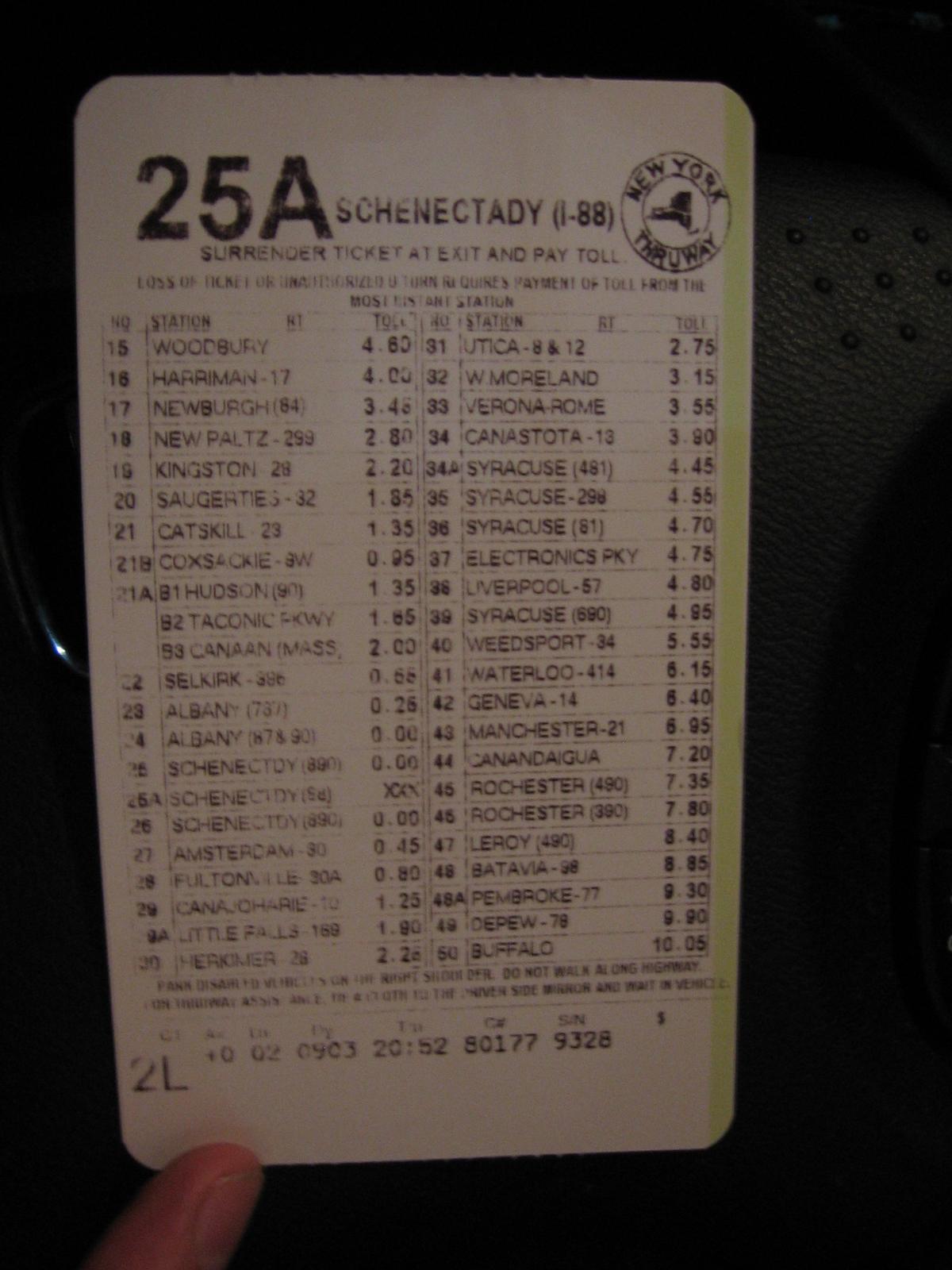

What an out-of-state driver faces before the first toll
If you are crossing into New York for a weekend road trip, the toll system you encounter is entirely cashless. There is no booth where you hand over bills or coins. Every charge is triggered by an overhead gantry that either reads a transponder or photographs your licence plate. That single fact shapes every cost decision you will make, because the rate you pay depends on which technology the gantry sees and which agency issued your account.
New York operates multiple tolling authorities that do not share a single rate structure. The New York State Thruway Authority, the Metropolitan Transportation Authority, the Port Authority of New York and New Jersey, the New York State Bridge Authority, and the Manhattan congestion zone each set their own rules. An out-of-state weekend driver can easily cross four of those systems in a single day without ever seeing a toll plaza.
The practical question is whether to bring your existing out-of-state E-ZPass, open a New York E-ZPass account before the trip, or rely entirely on Tolls by Mail. The answer changes the total cost of a weekend by a wide margin, and the research shows exactly where the gaps are widest.
The Thruway and the out-of-state penalty
The New York State Thruway mainline runs from the New York City suburbs to Buffalo, and on this road the rate split is stark. A standard two-axle passenger car under 7 feet 6 inches travelling the full distance from Exit 16 at Harriman to Exit 50 at Niagara Falls pays $17.60 with a New York-issued E-ZPass. The same trip costs $30.80 with any other E-ZPass or with Tolls by Mail. The Thruway Authority treats an out-of-state transponder the same as a licence-plate bill. There is no middle tier.
That single-leg difference of $13.20 repeats on every Thruway segment. A weekend that strings together several Thruway hops can quickly make the out-of-state rate feel punitive. The Governor Mario M. Cuomo Bridge, which carries I-87/287 across the Hudson north of New York City, follows the same logic. A Class 2L passenger car pays $7.25 with a New York E-ZPass and $12.69 with any other transponder or Tolls by Mail. The toll is collected only southbound, so a round trip across the bridge costs an out-of-state driver $25.38 versus $14.50 for a New York account holder.
If your weekend route includes significant Thruway mileage or a Cuomo Bridge crossing, the cost difference alone can justify the effort of opening a New York E-ZPass. The Thruway Authority has already published rates for future years, so the gap is structural rather than temporary.
MTA bridges and tunnels add a middle tier
The MTA Bridges and Tunnels system introduces a three-level rate structure that is more nuanced than the Thruway. On major crossings including the Bronx-Whitestone, Throgs Neck, RFK, Verrazzano-Narrows, Hugh L. Carey and Queens Midtown, a passenger car pays $7.46 with a New York Customer Service Center E-ZPass. An out-of-state E-ZPass lands in the Mid-Tier at $9.79. Tolls by Mail costs $12.03. The Henry Hudson Bridge follows the same pattern at lower absolute numbers: $3.42 for New York E-ZPass, $5.42 Mid-Tier, and $8.87 Tolls by Mail.
For the weekend driver, the Mid-Tier rate is the key detail. Unlike the Thruway, where an out-of-state transponder buys you nothing, the MTA does give a partial discount to non-New York E-ZPass holders. The savings over Tolls by Mail are real but modest. A single crossing on a major MTA bridge saves $2.24 with an out-of-state tag compared with a mailed bill. Across a weekend of several crossings, that adds up, but it never closes the gap with the New York E-ZPass rate.
The decision here depends on volume. If your itinerary includes two or three MTA crossings, the out-of-state tag is clearly better than nothing. If you are also paying Thruway tolls at the full Tolls by Mail rate, the combined penalty strengthens the case for a New York account.
Port Authority crossings and the weekend peak
The Port Authority of New York and New Jersey operates the George Washington Bridge, Lincoln Tunnel, Holland Tunnel, and the three Staten Island crossings. Its rate structure is the most expensive in the region and carries a timing rule that catches weekend drivers off guard. A Class 1 passenger car with a New York or New Jersey E-ZPass pays $14.79 off-peak and $16.79 peak. The Mid-Tier rate is $19.55, and Tolls by Mail is $23.30.
The critical detail for a weekend trip is that peak hours include Saturdays and Sundays from 11 a.m. to 9 p.m. A driver arriving at the George Washington Bridge on a Saturday afternoon is squarely in the peak window. An out-of-state E-ZPass holder does not receive the New York or New Jersey discount at all. The Port Authority applies only the Tolls by Mail rate of $23.30 to any account issued outside those two states. There is no Mid-Tier recognition for an out-of-state tag on these crossings.
That means a single Port Authority crossing with an out-of-state transponder costs $23.30, while a New York E-ZPass holder pays $16.79 during the same Saturday peak. The $6.51 difference on one crossing is larger than the entire toll on several Hudson Valley bridges. A weekend that includes even one Port Authority crossing makes the New York E-ZPass math compelling.
Hudson Valley bridges and the congestion zone
Not every toll in New York punishes the out-of-state driver. The five New York State Bridge Authority crossings in the Hudson Valley charge a flat rate regardless of where the E-ZPass was issued. A Class 1 car pays $1.65 with any E-ZPass and $2.15 via Tolls by Mail. Tolls are collected eastbound only. The Bear Mountain, Newburgh-Beacon, Mid-Hudson, Kingston-Rhinecliff and Rip Van Winkle bridges are the most egalitarian part of the system.
The Manhattan Congestion Relief Zone, covering local streets south of and including 60th Street, also treats out-of-state E-ZPass holders fairly. Any valid E-ZPass, regardless of issuing agency, pays $9.00 during the peak period and $2.25 overnight. Tolls by Mail costs $13.50 peak. Weekend peak hours run from 9 a.m. to 9 p.m. An out-of-state driver who has linked their licence plate to their existing account will be charged the E-ZPass rate, not the Tolls by Mail rate, for the congestion zone. This is a notable exception to the pattern seen on the Thruway and Port Authority crossings.
The congestion zone toll is scheduled to rise in future years under a phased structure. Before relying on the current rate, check the MTA congestion relief zone page to confirm which phase is active. The principle of equal E-ZPass treatment across all issuing agencies is the durable takeaway, even if the dollar amount shifts.
How to get a New York E-ZPass before the weekend
Anyone regardless of residency can open a New York E-ZPass account. The process is online at e-zpassny.com and requires a minimum $25 prepayment. The account is tied to a transponder that is mailed to the address you provide, so you need to allow delivery time before the trip. For a last-minute decision, New York also sells E-ZPass On-the-Go tags at participating retailers statewide. These are pre-packaged with a $25 balance and can be activated immediately. Retail availability changes, so confirm current locations on the Thruway Authority website before counting on an in-person purchase.
The tradeoff is straightforward. Opening a New York account saves money on the Thruway, the Cuomo Bridge, MTA crossings, and Port Authority crossings. It requires an upfront prepayment and a small administrative step. Keeping an out-of-state tag is simpler but costs more on every major crossing except the Hudson Valley bridges and the congestion zone. Relying on Tolls by Mail with no transponder at all is the most expensive option in every scenario, and it also means waiting for paper bills to arrive after the trip.
If your weekend route is confined to the Hudson Valley and you do not plan to enter the congestion zone, an out-of-state E-ZPass is perfectly adequate. The Bridge Authority crossings treat all tags equally, and the savings from a New York account would be negligible. If your route touches the Thruway, the Cuomo Bridge, any MTA crossing, or a Port Authority tunnel or bridge, the New York E-ZPass pays for itself within a handful of toll points.
Planning a route with toll costs in mind
The rate structures create natural cost boundaries that can shape a weekend itinerary. A loop that stays west of the Hudson and uses New York State Bridge Authority crossings will incur the lowest toll burden, with or without a New York E-ZPass. A route that crosses into New York City via a Port Authority tunnel or bridge and then heads up the Thruway will generate the highest toll total, and the penalty for not holding a New York E-ZPass will be at its maximum.
All rates are subject to periodic revision. The Thruway Authority has already published schedules for future dates, and the MTA congestion zone follows a published phase-in timeline. Before any trip, verify current rates through the Thruway Authority toll calculator and the relevant MTA and Port Authority pages. The relationships between the rate tiers are stable, but the dollar amounts move. The official operator to check for each crossing is the agency that collects the toll, not a third-party aggregator.
An out-of-state weekend driver who does nothing and drives with an existing tag will pay more than necessary on most crossings. The research is clear that the cost difference is not marginal on the Thruway and Port Authority crossings. Whether that difference matters enough to open a New York account depends on the route, but the numbers are large enough that the question is worth asking before the engine starts.
Sources and verification
- thruway.ny.gov — Research source checked for this guide
- liveroadsusa.com — Research source checked for this guide
- thruway.ny.gov — Research source checked for this guide
- mta.info — Research source checked for this guide
- panynj.gov — Research source checked for this guide
- nysba.ny.gov — Research source checked for this guide
Read next
-

 New York State Hotels for the Foliage Premium Weekend
New York State hotels for a weekend, from Adirondack great camps to Catskills motels, with foliage-season premium windows that shift every autumn.
-
 Where to Stay in New York State for a Weekend Base
Choose a New York State weekend base town by drive time from NYC or Boston, diner availability, and seasonal windows that determine whether you get foliage or black flies.
-
 Flying In for a Northeast Weekend and Which Airport Saves the Drive
Which New York airport to fly into for a weekend road trip, ranked by how much drive time each one saves you.
-
 New York State Weekend Drives Worth the Fuel Gauge
New York State weekend drives ranked by honest distance from New York City and Boston, with seasonal windows for foliage, black flies, and mud season that shift each year.
-
 Best Time to Visit New York State for a Weekend Drive
Find the right weekend window for New York State, with foliage, black fly, and mud season timing that shifts year to year, plus the honest case for November and April.
-
 Driving the Northeast for a Weekend Without Losing Friday
Which Northeast roads work for a Friday escape from New York City or Boston, with honest drive-time bands and seasonal hazard windows that shift each year.
-
 Catskills
 towns and hikes ranked by real Friday-afternoon drive time from Manhattan, with season windows.
-
 New York City
The weekend starts when you clear the merge. How to leave New York City by car on a Friday and get back in on Sunday without losing hours.
-
 Adirondacks
Adirondack towns and trailheads sorted by drive time from NYC and Boston, with black fly and mud season windows.